Showing posts with label performance art. Show all posts

Wednesday, July 22, 2009

Penelope Thompson “Interchange” installation and performance – Matsushiro Contemporary Art Festival (MCAF 2009 ), Nagano, Japan. July 5 – 20, 2009

On July 12, I set up an installation and did an art performance called “Interchange” at the 'Bunbu gakko' (Samurai School for Literary and Military Arts) in the historical village of Matsushiro, located in Nagano prefecture, Japan.

I was taking part in the annual Matsushiro Contemporary Arts Festival (MCAF), which consists of installation, performance art and contemporary dance events presented by artists from various Asian countries such as Japan, Korea, Myanmar, Singapore, etc. See website: http://mcaf.jp/index-e.html

The MCAF was started by Japanese art professor Hitoshi Kimura in 2002 (the year of the soccer World Cup collaboration between Japan and Korea). Prof. Kimura wanted to also help to build peaceful relations between the two countries through art, and the reason he chose the beautiful village of Matsushiro as the festival site is because of its surprisingly dark but little known war-time history, involving terrible human rights abuse of hundreds of Korean civilians.

This tragedy happened during the final months of WW II, after the Japanese Imperial government had decided on a plan to construct a massive underground set of tunnels in Matsushiro to secretly house the emperor and the military command. This was part of the nationalistic ideal to fight to the death of every man, woman and child to protect the Japanese empire.

So in November 1944, the construction of the tunnels started under a mountain in Matsushiro.

At that time Korea was under the colonial rule of Japan so many slave labourers (including female sexual slaves, now euphemistically known as “comfort women”) were brought from Korea for this top-secret project. Even the local Japanese people were not aware of what was going on, and they had no choice but to cooperate with the army's requests to surrender their houses and land. Even Japanese school children were made to give up classes to work to assist the war effort.

The Korean slaves were forced to work in appalling conditions and an incredible 13 kilometers of tunnels were dug in just a few short months. Many of the Koreans died from injuries, illness and malnutrition, but the actual identities and numbers of victims is unclear. Their plight was hidden because they had been forced to take Japanese names, and then all records of the tunnel construction were deliberately destroyed by the Japanese army upon their surrender in 1945.

The existence of the Matsushiro tunnels remained a secret until the late 1980's when local high school students discovered them. After learning about the dark history of the tunnels, the students petitioned the local government to preserve them as a public peace memorial so the story could be made known to all people.

Today the tunnels have been partially opened and reinforced so visitors can walk a few hundred meters into the damp darkness and get a sense of the desperate struggle of those war time years.

Nowadays, each July the Matsushiro Contemporary Arts Festival is held not far from the site of the tunnels. All of the foreign artists involved in MCAF are invited to first visit the tunnels to gain first-hand experience and inspiration for their work.

On July 5, 2009 Professor Kimura conducted a public workshop to make origami paper cranes as a symbol of peace, and these works were then painted and then photographed in the tunnels, before being installed in the 'Bunbu gakko' samurai school as part of the MCAF installation festival.

Description of Penelope Thompson's installation "Interchange" :
My installation was entitled 'Interchange' and was inspired by the issues of linguistic imperialism.

Because I have lived in Korea for many years I am very aware that during the time of the Japanese colonisation of Korea, Korean people were forced to learn Japanese language and to adopt Japanese names.

But I was moved very deeply by the realisation that the existence of the suffering and death of hundreds of Koreans in the Matsushiro tunnels had been almost completely obliterated through the use of language.

I chose to install the work on the verandah of the training room of the samurai school, "Bunbu Gakko". The installation consisted of the Japanese characters for “domination” 支配, from which were tied 70 stainless steel Korean chopsticks, individually hanging by red threads.

The stainless steel chopsticks are unique to Korea, and accordingly I chose them to represent the labor of the thousands of Koreans who worked as forced laborers or slaves to build the Matsushiro war-time tunnels. In the center of the chopsticks hung one small inverted stainless steel bowl, symbolizing the suffering of the Korean women who were brought to the tunnel construction site to serve as sexual slaves for the Japanese soldiers.

Although this work was overtly inspired by the Matsushiro war time tunnels, on a deeper level I wanted to express something about the universal spiritual side of the human struggle for liberation. I believe we must all make efforts to cut the ties that bind us to excessive fear and repression and find an authentic voice that can allow us more scope and freedom to build a better world.

I chose the title “Interchange” for the work because it expresses the ideas of communication and exchange, rather than a ‘win-lose‘ battle where one way of thinking simple replaces another without dialogue.


Description of Penelope Thompson's performance, "Interchange":

In this performance, the artist worked with her outdoor installation, entitled "Interchange".

The performance began with the artist walking across the wooden floor of the samurai school training room, singing the old Negro spiritual song "Motherless Child".


On reaching the hanging installation the artist brushed the hanging pieces to hear the soft voices of the metal pieces moving together.


She then lay on the ground under the steel chopsticks looking up at the Kanji character for "domination" 支配.


Then after a quiet period she arose and scraped the Korean Hangeul characters for “liberation” 자유 with her bare hands into the earth nearby, and then walked away.


Here's a video of the performance and the artist's talk afterwards:


Final Closing Ceremony - July 20, 2009
The installation then hung on the verandah of the samurai school training room for the following week - and visitors could touch the metal chopsticks to make sound.


On the final day of the MCAF festival, the artist held a symbolic ceremony, and invited the Japanese people to help her release the chopsticks from the red threads.


The Japanese audience members were then given a pair of the Korean stainless steel chopsticks as a symbol of goodwill.


As a final act the artist pulled down the Kanji character for domination.


A warm thank you to Professor Kimura, Ms Kaori Haba, and all the other artists, student volunteers, management and workers of the Matsushiro Samurai school, and audience members who contributed to this special arts festival.

Saturday, November 01, 2008

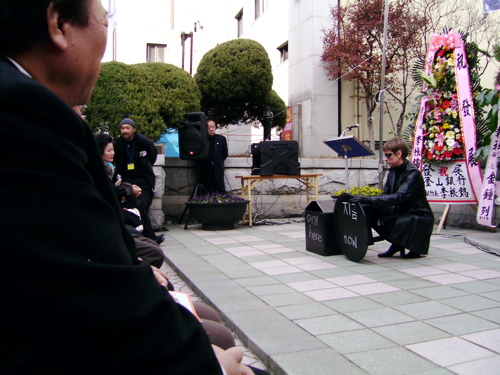
"Here & Now" opening performance, Danwon Arts Center, Ansan


Yesterday, I was invited to do the opening performance for the Korea Contemporary Art 1000 Artists Exhibition, held in the Danwon Arts Center in Ansan City, just south of Seoul.
This performance was called "Here & Now " and was a symbolic tea ceremony to celebrate the passion and creativity of the 1000 artists who joined together for this exhibition.


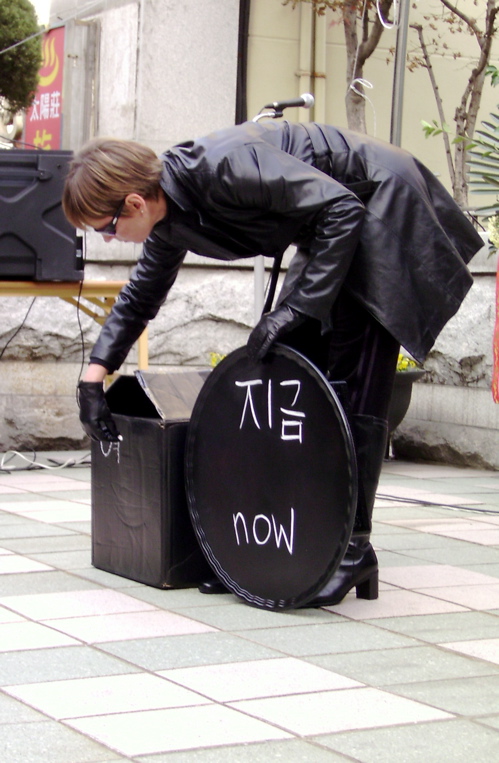
The artist rolls a circular black table symbolizing "now" until it intersects with a square black box symbolizing "here".


At the meeting point of "here and now", the artist inscribes these words in Korean and English and then begins to set up the table to perform a ritual tea ceremony.


A square black silk cloth is laid under the round table, and a square gold teatray,and jars of various spices are laid out.


The artist creates a multicultural and fragrant blend of tea and five different spices that are labelled (in Korean and English) as "courage", "passion", "persistence", "self-belief" and "audacity".

These spices represent some of the qualities that artists need to continue to create uplifting and inspiring art in a world that is all too often focused on destructive and materialistic endeavours.

The teapot is marked with an infinity sign, symbolizing the infinite power of human creativity and the infinite power of the "now" moment.


Thus the tea is called "infinitea", and the audience members are all invited to drink the tea to share in the special energy of the creative "now" moment.
You can see a video below:

Saturday, December 15, 2007

Portrait of foreign artist in Korea, 2007 - performance and installation by Penelope Thompson


On Tuesday, December 11, I presented the opening performance for an international group exhibition in Ulsan, Korea.
The group is called I.C.C. - International Creative Community - founded in 2006 by Australian artist Lainie Cooper and Korean artist Kim Chang han. I joined the group a few months ago, as I had not been involved in the Ulsan arts scene previously and I liked the strong Aussie connection.

The title for the exhibition is 'Impressions from Afar - A Visitor's Perspective', and it will continue at the Bukgu Culture & Arts Center, in Ulsan until December 20, 2007. All the contributing artists were asked to create artworks based on their impressions of a foreign country, so the Korean artists exhibited works based on their overseas travels to countries such as India , Australia or Africa, and the foreign artists created works based on their experiences in Korea. Some Australian ICC member artists sent over work based on their cultural exchange trip to Korea in June 2007.


For this exhibition I decided to prepare an installation and performance similar to my very first art performance in Korea (Portrait of a foreign artist in Korea') that I did in Sungsan Art Hall, Changwon in February 2004. Click here to see 2004 performance .

The reason I chose to revisit this theme is simple - being an artist for a foreigner like me in Korea is still technically illegal under immigration law. It's a Catch 22 situation - there are no visas available for self-funded artists to stay in Korea, (only short 6 month Arts & Entertainment visas for entertainers sponsored by large companies), so to live here and experience Korean culture and make art, I have to remain an English teacher, but on an E2 teaching visa I am actually not allowed to partcipate in any other activities, even as a volunteer!

There was big kerfuffle last year when some Busan teachers put on a play for the foreign community and were subsequently raided by the police, arrested, and threatened with deportation. So it came as a shock for me to realise that three and a half years after my initial artwork on this theme, as a foreign artist I am still dealing with the same immigration status issue, long working hours as an English teacher, less than ideal living conditions, and little time to make art. Although I worked very hard to secure a higher level university teaching job that promised short hours and long vacations, those conditions failed to materialise.... It seems like it's time for a new plan of action.

In my performance, I begin zipped up inside a large suitcase and emerge to the ringing of an alarm clock. I hang the clock on the wall in a prominent position.
Then, I pull out a painting from the suitcase of an Australian native bird that I painted in Australia several years ago, and brought with me when I came to Korea. This painting shows the bird extending its wings while its feet are still firmly on a branch of a dead tree.

I contemplate the painting, open a new sketchbook, and sharpen a pencil.


But a quick glance at the clock shows me it is time to prepare for my teaching job. So I put on my white shirt and formal black suit, covering up my comfortable colorful clothes, then zip up some hard black boots and proceed to teach an English lesson to the audience.


I pull out a whiteboard marker and draw an equals sign next to the clock on the wall.


I ask the "class" to guess which common English expression regarding time I am trying to demonstrate. When I stick a 10,000 won note after the = sign the message is clear - "time is money". I ask the class to practice the saying with great enthusiasm, and then my English class is over.

Returning to the suitcase, I remove my teaching costume and begin to place the clothing very carefully on the hanger, arranging it so it looks like a person might still be inside. I take the whiteboard marker and quickly sketch a self-portait of my face in the sketch book. I tape this picture to the coathanger holding the suit of clothes, and arrange the boots so they stand to attention underneath the hanging skirt.
The final touch is to add lipstick to my self- portrait.

Then with more energy, I unwrap a new large paintbrush and a tub of red paint and paint a thick line through the "time is money" - blotting out the clock, the = , and even the 10,000 won note.
I write graffiti in large red letters on the wall - ART IS LIFE!.

Finally, smiling, and with brush and paint in hand I leave the scene of the crime!

Here's the video of the performance:


Note for those in Korea:
You can see the exhibition (free entry) at Bukgu Culture & Arts Center Gallery, 1010 Saneopro, Bukgu, Ulsan until Dec. 20. Gallery enquiries Tel: 052-219-7400
Membership of I.C.C. is open to any emerging or established artists of any nationality who are interested in cultural exchange. Please contact Kim Chang Han: Tel: 018-591-3338

Monday, October 29, 2007

The Elements#2 - Goryeong International Performance Art Festival 2007


I was invited to the Goryeong International performance Art Festival in central Korea for the second time on October 20, 2007.There were several performance artists from countries including Japan, Australia, and Korea.

My performance title was "The Elements#2" - in which I made art using only the four elements of fire, earth, water and air.
This was a site specific performance and my performance area was a lovely stone sculpture set in the garden of the Goryeong Artists' Village.


At first I set up 4 glass cups, and added to each cup one of the elements - some rainwater, a burning candle, some air, and some earth from the surrounding garden.


I then proceeded to make an origami box from a large piece of paper.


When my paper-folding was complete I inflated the paper box with my breath (air).


I then mixed the earth and water together to make a painting medium.


With a calligraphy brush I painted ancient alchemical designs representing each of the 4 elements on the sides of the box.

These traditional symbols are based on the form of the triangle - a point-up triangle for fire, point-down for water etc.


To end the performance, I took fire from the candle flame and burned the box to ashes, and doused the smouldering remains with water - thus completing my use of the elemental quartet.


You can watch a 5 minute video below:

Sunday, September 16, 2007

Chungju International Performance Art Festival, Korea

On Wednesday, September 12, I travelled to Chungju City to take part in the Chungju International Performance Art Festival.

The venue was a traditional old Korean building and there were many schoolchildren in attendance as there was also an art competition for the students to paint or draw the performance artists.

My performance was 'The Beauty Myth', which I had previously performed in 2005 at the Seoul Experimental Art Festival. This performance shows an image of a woman passively waiting to be rewarded for conforming to society's ideal of beauty.


Her style combines elements from classical sculpture of female form, the traditional white wedding dress and modern fashion magazine ideals of beauty.

She is watched by a man who gives her gifts of balloons, which she blows up but which burst or fly away. In this way the artist is questioning the real value of rewards received by women for conforming to the ideals of the “Beauty Myth”.

Finally, the woman chooses to emerge from her restrictive costume, and the performance of 'The Beauty Myth' is over.


After the performance the schoolchildren pulled out their sketchpads and paints.

There were hundreds of children painting or drawing their favorite performance artists for the art competition.You can watch a short video of the children painting here:


The "lady in the white dress" was a popular subject!

Tuesday, December 19, 2006

ONE ART STREET - "Here & Now" performance by Penelope Thompson


Today I did a performance for the opening of the ONE ART STREET exhibition at the Baeksan Memorial Hall in Jungangdong, Busan.This was a mixed exhibition from both local Korean and foreign artists - including photography, sculpture, painting, performance etc. - on show until Dec 28, 2006.

The area around the exhibition site was historically the real hub of art activities in Busan. It was known in earlier days as 'Art Street' and local artists want to see it happening again, to counteract the big shift of artistic happenings to the wealthy Haeundae area. My performance was called "Here & Now (TEAROOM no. 1)" and was a symbolic ceremony to celebrate the rebirth of the art scene in the area.

My performance was also a reaction to the Busan Biennale which finished recently, with the theme of art "everywhere" and CAFE (contemporary art for everyone). I wanted to show art as being "here & now" made by local artists and accessible to local people - and in the format of a traditional Korean tearoom, not a westernised notion of a cafe.

In the performance the artist rolled a circular black table (symbolizing "now") until it intersected with a square black box (symbolizing "here").

At the meeting point of "here and now", the artist performed a symbolic , ritual tea ceremony - concocting a multicultural and fragrant blend of tea and spices.

The spices were labelled (in Korean and English) as "courage","passion", "persistence', "self-belief" and "patience" -representing the qualities that artists need to make art. This was also relevant to the exhibition venue being the Memorial Hall for the Busan citizens' resistance against the Japanese colonial forces during the first part of the 20th century.

The tea was prepared in a teapot marked with an infinity sign, symbolizing the infinite power of human creativity and the infinite power of the "now" moment. The tea was called "infinitea".The audience members were all invited to drink some "infinitea" and thus share in the special energy of the moment.
Watch a short video of the performance:
Here & Now- TEAROOM No1- performance art by Penelope Thompson

Add to My Profile | More Videos